
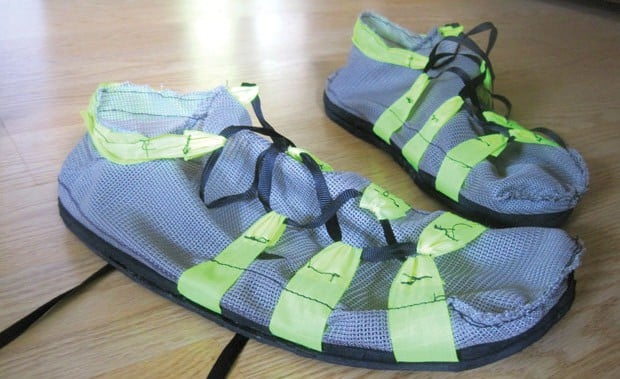
Get and share ideas for making your own minimalist running shoes at homemadeshoes.wikispaces.com.
Not too many years ago, I sat down in front of a sewing machine for the very first time. Sweat streamed from my furrowed brow as I tried to sew the shoulder straps to a homemade backpack. I’ll admit that I mumbled more than a few curse words as I painstakingly undid some misdirected seams. But by the end of the day, I had my very first project completed and was eager to test it out in the field.
That very same pack went on to serve me well on thru-hikes of the Colorado and John Muir Trails. I later redesigned and reused the same materials to build a framed pack for a 2007 Appalachian Trail thru-hike. As confidence in my skills grew, I added articles of clothing, tarps, tents, bicycle panniers, sleeping bags, and even running shoes to my do-it-yourself resume.
Most everyone is familiar with the three Rs: reduce, reuse and recycle. Although the latter of the three, recycling, seems to get most of our attention, reducing could have an even greater positive impact. How do environmentally conscious outdoor fanatics balance a love of gear with a desire to reduce their ecological footprint?
Mainstream outdoor manufacturers may be shipping in “greener” products from faraway lands to sell to you, but perhaps the better answer resides in three other R’s: raise, repair, and regionalize. So what do these mean? Just as it is desirable to have a garden to raise your own food, it’s good to have a sewing machine to make your own gear. It need not be that expensive an investment: over a decade ago, my mom bought me a sewing machine (the same one that I still use to this day) at a local yard sale for five dollars.
Now that you have a sewing machine, stores like Foam and Fabrics Outlet provide DIYers with an assortment of materials to build all sorts of gear and clothing. Patterns and construction tips are readily available on the internet. There is a burgeoning online community of DIYers out there and MYOG (make your own gear) forums abound.
Some people I’ve talked to about making gear often say things like, “Well, I’d love to try this, but I’d rather spend my free time doing something outside!” This is a valid point, but I rarely regret my time in the shop building and creating. It’s a perfect therapy for dreary days. Maybe it all traces back to playing with Lego bricks growing up, but I hardly ever follow a pattern.
Building gear from scratch can be tedious and frustrating, but the sense of empowerment that comes from using a finished product is priceless. DIYers can also get more from their gear through repair. Once you learn how to put something together, you will know how to keep it together. All too often, people get rid of damaged articles of clothing and gear that are perfectly fixable. Outdoor enthusiasts would be less inclined to dispose of these items had they a better sense of the time and energy invested in each product.
The last of the three other R’s, regionalize, is all about keeping it local. Perhaps you don’t have the time or tenacity to make your own gear. I can assure you that there are local seamstresses, even local outdoor gear manufacturers, who would be eager to help you reduce your carbon footprint. It’s great to bolster the local economy, but I’d still encourage as many people as possible to learn a little more about making gear and clothing. Even if most projects don’t pan out, you’ll come away better prepared to fix the gear you buy.
Even after a decade using handmade gear, I still catch myself thinking that somehow the equipment I make isn’t as good as what I could buy. Is it because my seams aren’t as straight or there are extraneous strands of thread left untrimmed? Surely the mesh fabric I bought from the local fabric store on sale isn’t as fancy as the cutting-edge stuff that the top gear manufacturers are using. So is it really worth all the time and energy to embrace such a hobby? I’ve alluded to a few snags for beginning gear makers, but consider this tale of triumph:
For me, the efficacy of homemade equipment became clear in the summer of 2009 when I completed a fast pack of the 288-mile Benton MacKaye Trail in less than six days. Most of the gear I carried was homemade. Because I custom fit it to my body, the mesh pack that I used on this ambitious journey—yes, made from fabric on sale for a buck per yard—carried my water and other supplies far better than any I could’ve bought from a store. In fact, this very same pack is still going strong after another trip this summer along the 930-mile Mountains-to-Sea Trail.
We’ve been programmed in this country to be consumers, but not irreversibly so. Hopefully outdoor fanatics can break free of such a mindset. After all, there is indeed another way to get outfitted for the outdoors.
Watch Matt Kirk run in handmade running shoes wearing a hand-sewn backpack on record-setting runs across the Southern Appalachians.
Get Started on Your Gear
Read all about it. Research patterns and ideas for gear/clothing projects from websites like http://thru-hiker.com
Ask all about it. Consult veteran seamstresses (e.g. moms) for tricks of the trade. If you don’t know anybody personally, consult help forums online.
Ease into it. Start with simple sewing projects like stuff sacks to avoid feeling overwhelmed.
Hold onto it. Save buckles, straps and scrap fabrics from old gear for future projects. You never know when you could use a ladder lock again.


